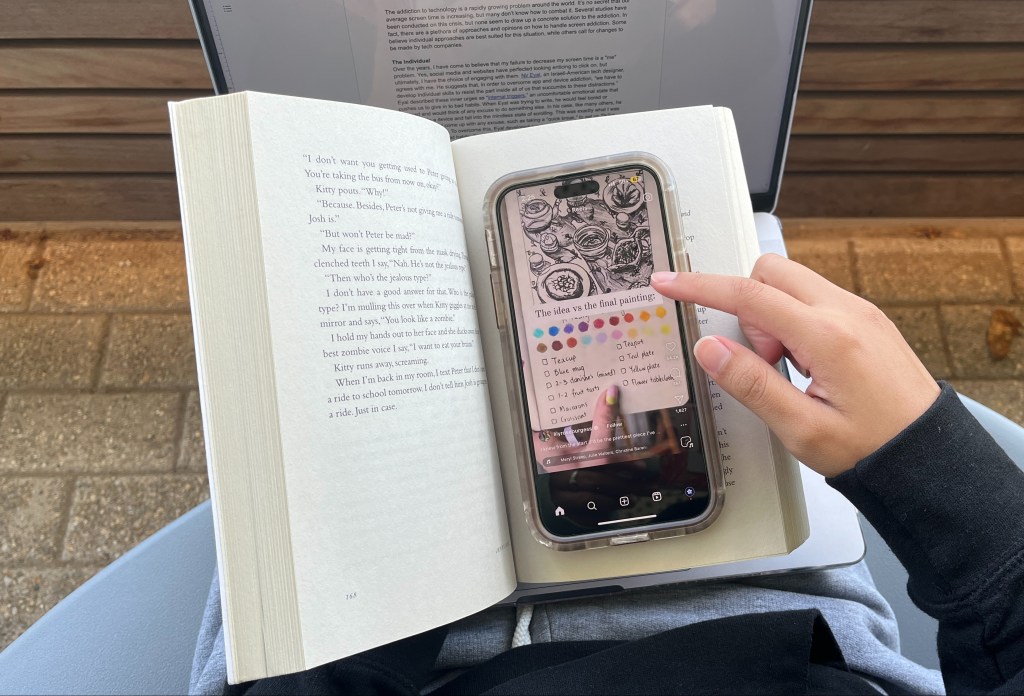
The addiction to technology is a rapidly growing problem around the world. It’s no secret that our average screen time is increasing, but many don’t know how to combat it. Several studies have been conducted on this crisis, but none seem to draw up a concrete solution to the addiction. In fact, there are a plethora of approaches and opinions on how to handle screen addiction. Some believe individual approaches are best suited for this situation, while others call for changes to be made by tech companies.
The Individual
Over the years, I have come to believe that my failure to decrease my screen time is a “me” problem. Yes, social media and websites have perfected looking enticing to click on, but ultimately, I have the choice of engaging with them. Nir Eyal, an Israeli-American tech designer, agrees with me. He suggests that, in order to overcome app and device addiction, “we have to develop individual skills to resist the part inside all of us that succumbs to these distractions.” Eyal described these inner urges as “internal triggers,” an uncomfortable emotional state that pushes us to give in to bad habits. When Eyal was trying to write, he would feel bored or stressed and would think of any excuse to do something else. In his case, like many others, he would turn to a device and fall into the mindless state of scrolling. This was exactly what I was going through. I’d come up with any excuse, such as taking a “quick break,” to get on TikTok and avoid my tasks. To overcome this, Eyal developed a range of techniques aimed at interrupting these bad habits. Two that stood out most to me were the ten-minute rule and changing notification settings. If you have the urge to check your device, wait ten minutes. This gives you time to really think about whether you want to check or just need a break. As for the notification changes, I applied this myself after participating in my five-day digital detox. I turned off all notifications from TikTok and Instagram and have already experienced greater focus and fewer distractions.
Conflicting Approaches
Eyal represents one approach, while Tristan Harris argues the opposite—that changes must be made to tech companies, not to individuals. There is truth in what Eyal recommends; small changes can have an impact. Tech companies have even created features to help us unplug: screen time limits, “Do not disturb” modes, app usage limits, and more. Johann Hari, author of Stolen Focus, points out that this approach is how tech companies want us to view our attention problem—an addiction controlled by us, not them. Nir wrote in his book Hooked that tech companies are in the persuasion business. Their goal is to create products that keep you coming back. The individualistic solutions Eyal and companies offer don’t take into consideration (or maybe just ignore) the environmental and real-life situations of people. Tristan testified to this in court: “You can try having self-control, but there are a thousand engineers on the other side of the screen working against you.”
Change in Tech Companies
If individual solutions aren’t the right approach, then what is? Tristan Harris and Aza Raskin propose two large-scale changes. The first is to ban surveillance capitalism. This is a drastic change, but they explain that companies would switch from working against you to working for you. They could shift to a subscription model, figuring out what makes you happy instead of what makes advertisers happy. The second approach is for tech companies to be bought by the government and for social media to be recognized as an essential public utility (public ownership). The most obvious form of change is for companies to redesign their apps and websites. This is the simplest and easiest way to stop mental pollution. They could send one notification per day (a summarized daily update) or turn off “infinite scrolling” to deter excessive screen time. Social media could also be turned into a tool for socializing. It could ask you about your interests and hobbies, then set you up with people of similar interests out in the world to meet up with. Aza says this is “a way of socially surrounding yourself with the behavior that you want.”
Overcome
Despite the long lists of techniques and formal proposals to combat app and site addiction, real change starts with us. We must first overcome “cruel optimism,” the simplistic individual solutions companies offer in upbeat language, often so limited that many will fail. Then we can turn to “authentic optimism,” where, together, we build a solution that actually addresses the underlying causes of the problem. This is not a simple process and will take time and effort by society as a whole to challenge. It’s clear that we are only at the start of surveillance capitalism, but nothing is too big or impossible to achieve when ordinary people work together.
 The Designer's Nook